
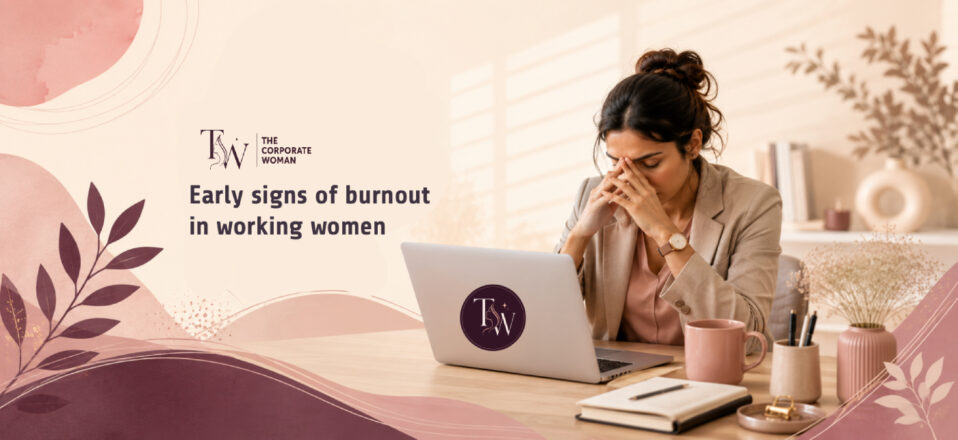
Early Signs of Burnout in Working Women
I Was Not Lazy. I Had Early Signs Of Burnout.
And nobody told me those were two very different things.
Burnout in working women does not arrive with a warning. It does not tap you on the shoulder and announce itself. It builds quietly, over weeks and months, until one ordinary Tuesday you sit in front of your laptop for forty minutes and type nothing.
The cursor blinks. You stare back. Three deadlines. A client call in an hour. A to-do list that grows faster than you can cross things off. And your brain has simply stopped.
Not sadness. Not anger. Just hollow.
I told myself I was tired. I told myself I needed the weekend. I told myself this is what ambition costs, and that every serious woman goes through phases like this.
I was wrong. That was burnout. And I did not recognise it, because no one had ever described it to me honestly.
“We have been sold a myth. The myth that work-life balance is a schedule you achieve. That if you wake up earlier, plan better, and say no more often, you will crack the code. Burnout does not come from bad time management. It comes from carrying too much, for too long, without enough of yourself left over.”
Work-life balance gets framed as a personal responsibility problem. If you burn out, the implication is that you failed to balance. That you did not protect your mornings. That you should have meditated more.
The truth is messier. Burnout is the result of systems that demand more than they return. And for working women, those demands stack up in ways that are rarely acknowledged. If you want to understand exactly why this myth was broken from the start, read our full breakdown: Why Work-Life Balance Is a Myth in 2026.
What Burnout in Working Women Actually Looks Like
Most people picture burnout as a dramatic breakdown. A resignation letter. Tears in the bathroom at work. That is not how it usually shows up.
It creeps. It wears the costume of ordinary tiredness, mild irritability, and slight disinterest. By the time it looks obvious, it has already gone deep.
Here is what it looked like for me, and what I hear from other women too:
|
In your body Waking up already exhausted. Headaches that do not fully go away. Getting sick far more often than before. |
In your mind Forgetting small things. Struggling to focus on tasks you used to handle with ease. Everything feeling heavier than it should. |
|
In your emotions A strange flatness. Not quite sadness, not quite anger. Just numbness. Snapping at people you love without understanding why. |
In your behaviour Pulling away quietly. Skipping hobbies. Watching hours pass on your phone, not to relax, but because you have nothing left to give. |
None of these feel like emergencies on their own. Each one is easy to explain away. Together, over time, they are your body and mind sending a clear signal: the well is running dry.
Why Burnout in Working Women Runs So Deep
Most of us do not need research to confirm this. We have lived it.
The pressure to prove competence constantly. To stay warm and agreeable while also being taken seriously. To manage the home to-do list alongside the work one, without either slipping.
Working women also face fewer decision-making opportunities, higher rates of being over-qualified for their actual roles, and fewer professional alternatives to turn to. That combination creates its own slow, grinding pressure.
Then there is the invisible weight of performing okayness. Saying “I am fine” in meetings when you are not. Smiling through exhaustion because admitting you are struggling feels risky.
The work-life balance myth compounds all of this, because it keeps the solution pointed inward. More yoga. Better routines. A gratitude journal. These are not bad things. But they do not fix the root. They treat the symptom while the cause keeps running.
The data behind this is striking. 59% of women globally report burnout compared to 46% of men. In India, 68% of working women say they have never felt balanced. These are not personal failures. They are patterns in a broken system. We break down the full numbers in our piece on why work-life balance for women was always a structural lie.
“You cannot meditate your way out of an environment that depletes you faster than you can recover. Recovery needs rest, yes. But it also needs a lighter load.”
What Actually Helped Me Recover
This is not a ten-step programme. But here is what genuinely shifted things, slowly and imperfectly:
01 — Naming it without shame
The moment I stopped calling it “a rough patch” and named it burnout, something loosened. It became a real thing to address, not a personal flaw to hide.
02 — Dropping the “everything, perfectly” standard
A heavy project week meant laundry waited. A hard month meant weekends became rest, not catch-up time. Balance shifts. That is not failure. It is what real work-life integration actually looks like.
03 — Moving my body for relief, not results
Not to be fit. Not to look a certain way. Just a walk, a stretch, a quiet gym session to feel like I lived in my body again, not just my inbox.
04 — Being fully present with the people I love
Not scrolling next to them. Not half-listening while planning tomorrow. Actually being there. Real presence turned out to be the most restorative thing I had been skipping.
05 — Talking to other women
Coffee with friends who understood. Not to fix anything, just to be heard. Finding out you are not alone, and not wrong for feeling this way, carries real weight.
06 — Treating “no” as a complete answer
Saying no to things that did not serve me. Delegating without guilt. Stopping constant availability. These were not boundaries for other people. They were oxygen for me.
Busting the myth
Balance was never a perfect schedule to achieve. It was never about squeezing self-care into the gaps between everything else.
It is about recognising that you are not a machine. The world gets the best of you when you actually have something left to give. Recovery is not selfish. Recovery is how you stay.
The Superwoman ideal, the expectation to do everything and never let anything drop, is the same myth dressed in different clothes. Read how the Superwoman trap keeps working women stuck, and what it looks like to finally step out of it.
If the exhaustion has turned into anxiety, if your body keeps raising the alarm, if the numbness has settled in too long, please reach out to a mental health professional. Not as a last resort. As a first act of care for yourself.
Burnout in working women does not mean failure. It means you carried too much, for too long, with too little support. You are not broken. You are human. And that is exactly enough to start from.
